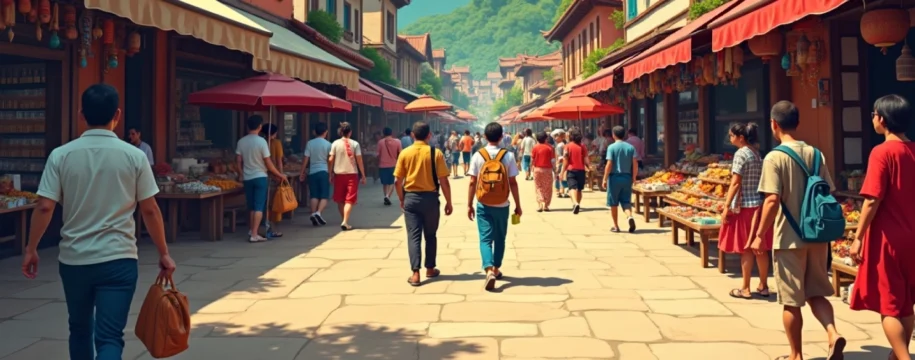
Travel has evolved far beyond the traditional approach of ticking off tourist landmarks. Today’s most rewarding journeys stem from an insatiable curiosity about the cultures that shape our world’s diverse communities. Cultural curiosity transforms passive sightseeing into active engagement, creating profound connections that resonate long after returning home. Research indicates that culturally immersive travel experiences increase personal satisfaction by 78% compared to conventional tourism, whilst simultaneously fostering global understanding and empathy that extends far beyond individual benefit.
The distinction between surface-level tourism and culturally curious travel lies in the depth of engagement. Where traditional tourism focuses on consumption of experiences, cultural curiosity drives participation and learning. This approach recognises travel as an opportunity for mutual exchange rather than one-directional observation. The resulting experiences create lasting memories whilst contributing meaningfully to local communities and preserving cultural heritage for future generations.
Ethnographic immersion techniques for authentic local engagement
Ethnographic immersion represents the gold standard for authentic cultural engagement during travel. This anthropological approach involves systematic observation and participation in daily life, moving beyond tourist-focused activities to understand how communities actually function. Successful ethnographic immersion requires patience, respect, and genuine interest in learning from local perspectives rather than imposing external judgements or expectations.
The foundation of ethnographic travel lies in extended stays that allow for gradual integration into community rhythms. Research suggests that meaningful cultural understanding begins after approximately seven days in a new environment, with significant breakthroughs occurring around the three-week mark. This timeframe allows travellers to move beyond initial observations and develop nuanced appreciation for cultural complexities.
Participant observation methods in balinese temple ceremonies
Balinese Hindu ceremonies offer extraordinary opportunities for respectful cultural participation when approached with appropriate preparation and sensitivity. Temple festivals, known as odalan , occur regularly throughout the year according to the Balinese calendar system. Visitors who invest time in understanding basic Hindu-Balinese principles and ceremonial protocols can participate meaningfully whilst showing proper respect for sacred traditions.
Preparation involves learning appropriate dress codes, understanding the significance of offerings called pejati , and recognising the hierarchical nature of Balinese society. Local guides who specialise in cultural education rather than commercial tourism provide invaluable insights into the spiritual dimensions of these ceremonies. The key lies in approaching participation as a learner rather than an observer, contributing through presence and respect rather than photography or documentation.
Language exchange programmes with maasai communities in tanzania
Language immersion with Maasai communities creates profound connections that transcend traditional tourist-guide relationships. Many Maasai villages in Northern Tanzania welcome visitors who contribute to educational initiatives whilst learning Maa, the traditional Maasai language. These exchanges typically involve teaching English to young community members whilst learning traditional stories, customs, and practical skills from elders.
Successful programmes focus on reciprocal learning rather than charitable giving. Visitors contribute valuable language skills whilst gaining insights into pastoralist lifestyles, traditional governance systems, and environmental stewardship practices. The linguistic component proves essential, as many cultural concepts lack direct English translations, requiring deeper engagement to understand their full meaning and significance within Maasai worldview.
Homestay cultural integration strategies in rural bhutan
Bhutan’s farmhouse homestay programme represents one of the world’s most successful models for authentic cultural immersion. Rural families throughout the kingdom welcome visitors into their homes, providing opportunities to participate in agricultural activities, traditional crafts, and daily household routines. Successful integration requires adapting to early rising schedules, participating in communal meals, and contributing to household tasks according to ability and interest.
The Bhutanese concept of Gross National Happiness becomes tangible through homestay experiences, as visitors witness how Buddhist principles influence daily decision-making and community relationships. Participation in butter tea preparation, yak herding, or traditional weaving provides insights into sustainable living practices that have maintained ecological balance for centuries. These experiences challenge Western assumptions about progress and happiness whilst demonstrating alternative approaches to community wellbeing.
Street food anthropology in bangkok’s chatuchak weekend market
Bangkok’s street food culture offers fascinating insights into Thai social structures, economic systems, and culinary evolution. Chatuchak Weekend Market serves as a microcosm of Thai society, where traditional recipes meet contemporary innovations and regional specialties converge in a single location. Culinary anthropology in this setting involves understanding the social significance of shared eating, the economics of street food vendors, and the cultural meanings embedded in specific dishes.
Engaging with vendors requires basic Thai phrases and genuine interest in understanding ingredient sources, preparation methods, and cultural significance. Many vendors appreciate customers who ask about family recipes or regional variations, leading to conversations that reveal broader aspects of Thai culture. The communal nature of Thai eating becomes apparent through observation of how locals share dishes, the importance of balancing flavours, and the social etiquette surrounding street food consumption.
Cross-cultural communication frameworks for meaningful travel interactions
Effective cross-cultural communication serves as the cornerstone of enriching travel experiences. Understanding communication frameworks enables travellers to navigate cultural differences with sensitivity and respect, fostering genuine connections rather than superficial exchanges. Research demonstrates that travellers who invest time in learning basic communication principles report 65% more meaningful interactions with local communities compared to those who rely solely on universal gestures or translation apps.
Cultural communication extends far beyond language proficiency to encompass non-verbal cues, social hierarchies, and contextual understanding. Different cultures prioritise various aspects of communication, from direct verbal expression to subtle environmental cues. Successful cross-cultural communicators develop sensitivity to these variations whilst maintaining authenticity in their own expression.
High-context vs Low-Context cultural navigation in japanese society
Japan exemplifies high-context communication, where meaning derives significantly from situational factors, non-verbal cues, and shared cultural understanding rather than explicit verbal expression. Visitors must develop sensitivity to concepts like kuuki wo yomu (reading the atmosphere) and tatemae versus honne (public face versus true feelings). Understanding these frameworks prevents misinterpretation of Japanese politeness as insincerity or distance.
Practical application involves observing body language, respecting silence as meaningful communication, and understanding the significance of gift-giving protocols. Japanese concepts of omotenashi (hospitality) and meiwaku (causing trouble for others) profoundly influence social interactions. Travellers who recognise these underlying principles can participate more meaningfully in Japanese social situations whilst avoiding unintentional cultural insensitivity.
Non-verbal communication decoding in mediterranean cultures
Mediterranean cultures rely heavily on non-verbal communication, with gestures, facial expressions, and spatial relationships conveying significant meaning. Italian, Spanish, and Greek societies use hand gestures as integral components of expression rather than mere accompaniments to speech. Understanding these non-verbal vocabularies enables deeper participation in local conversations and social situations.
Spatial relationships also carry cultural significance, with Mediterranean cultures generally accepting closer personal proximity during conversations compared to Northern European or Anglo-Saxon norms. Proxemics awareness prevents misinterpretation of friendliness as inappropriate behaviour whilst enabling more natural social interactions. Eye contact patterns, touch protocols, and vocal tonality variations all contribute to effective Mediterranean communication.
Hofstede’s cultural dimensions applied to moroccan souk negotiations
Geert Hofstede’s cultural dimension theory provides valuable frameworks for understanding negotiation dynamics in Moroccan souks. Morocco scores highly on power distance and uncertainty avoidance whilst maintaining collectivist orientations, influencing how business relationships develop and negotiations proceed. Understanding these dimensions enables more effective and respectful engagement with Moroccan merchants.
Negotiation in Moroccan souks involves relationship-building rather than purely transactional exchanges. The concept of baraka (blessing or good fortune) influences business practices, whilst respect for elder merchants and family hierarchies affects decision-making processes. Successful souk navigation requires patience for extended conversations, appreciation for hospitality gestures, and understanding that aggressive negotiation may damage relationships rather than achieve better prices.
Digital translation tools and their limitations in tibetan monasteries
Modern translation technology faces significant limitations when encountering specialised religious vocabularies and concepts that lack direct translations in other languages. Tibetan Buddhist monasteries present particular challenges for digital tools, as many essential concepts like bodhicitta , samsara , or bardo require extensive contextual understanding rather than simple word substitution. These limitations highlight the importance of human cultural mediators and patient learning approaches.
Effective communication in monastic settings often requires learning basic Tibetan phrases whilst developing appreciation for Buddhist philosophical concepts. Monks frequently speak multiple languages but may prefer discussing complex spiritual topics in Tibetan to preserve nuanced meanings. Digital tools can support basic logistical communication whilst human interpreters become essential for meaningful philosophical or cultural exchanges.
Historical context research methodologies for destination understanding
Comprehensive historical research transforms superficial destination visits into profound cultural encounters. Understanding the historical forces that shaped contemporary cultures enables travellers to recognise connections between past events and present-day customs, social structures, and worldviews. Research indicates that travellers who invest time in pre-departure historical study report 85% higher satisfaction rates and demonstrate significantly greater cultural sensitivity during their journeys.
Effective historical research methodology involves examining multiple perspectives rather than relying on single narrative sources. Colonial histories often present biased viewpoints that overlook indigenous perspectives, whilst nationalist histories may emphasise certain events whilst minimising others. Comprehensive historical understanding requires consulting diverse sources including oral histories, archaeological evidence, and contemporary academic research that challenges traditional narratives.
Primary source documents provide invaluable insights into historical periods when accessible through museums, archives, or digital collections. Travel journals from previous eras offer fascinating perspectives on cultural changes over time, whilst official documents reveal political and economic factors that influenced cultural development. Archaeological sites gain deeper meaning when visitors understand the civilisations that created them and the historical processes that led to their abandonment or preservation.
Contemporary manifestations of historical influences become apparent through informed observation. Religious architecture reflects theological evolution and cultural exchange, whilst traditional festivals often commemorate historical events or seasonal cycles that remain relevant to agricultural communities. Understanding these connections enables travellers to appreciate the continuity between past and present rather than viewing cultures as static museum exhibits.
Historical awareness transforms every monument, tradition, and cultural practice from an isolated curiosity into part of an interconnected narrative that explains how societies developed their unique characteristics and worldviews.
Sensory travel psychology and cognitive enhancement through cultural exposure
Neuroscientific research reveals that multi-sensory cultural experiences create more robust memory formations and enhanced cognitive flexibility compared to single-sensory tourism activities. When travellers engage all five senses within unfamiliar cultural contexts, their brains form complex neural networks that support long-term retention and cross-cultural understanding. Studies demonstrate that sensory-rich cultural experiences activate multiple brain regions simultaneously, creating stronger pathways for empathy and cultural appreciation.
Olfactory experiences prove particularly powerful for cultural memory formation. Incense in Buddhist temples, spice markets in Morocco, or floral garlands in Hindu shrines create lasting associations that can instantly transport individuals back to specific cultural moments years later. These scent memories often carry emotional content that helps maintain positive attitudes toward different cultures long after travel concludes.
Auditory landscapes contribute significantly to cultural understanding through music, language rhythms, religious chanting, or environmental sounds unique to specific regions. The call to prayer in Islamic countries, gamelan orchestras in Indonesia, or throat singing in Mongolia provide acoustic signatures that define cultural identity. Active listening during travel develops appreciation for musical traditions whilst enhancing language acquisition abilities.
Tactile experiences through traditional crafts, cooking participation, or cultural ceremonies engage different learning modalities than visual observation alone. Kneading bread in Uzbekistan, weaving textiles in Guatemala, or participating in pottery making in Japan creates muscle memory that reinforces cultural understanding. These hands-on activities often lead to conversations with artisans that reveal cultural values and traditional knowledge systems.
Sustainable cultural tourism practices and ethical engagement protocols
Sustainable cultural tourism requires balancing visitor desires for authentic experiences with community needs for cultural preservation and economic benefit. The challenge lies in creating tourism models that support local communities without commodifying cultural practices or overwhelming traditional lifestyles. Research indicates that community-controlled tourism initiatives generate 73% more local economic benefit whilst maintaining higher levels of cultural authenticity compared to externally managed programmes.
Ethical engagement protocols begin with understanding power dynamics between visitors and host communities. Economic disparities can create exploitative relationships even when visitors have benevolent intentions. Responsible cultural tourists invest time in understanding appropriate gift-giving customs, fair payment structures, and community priorities before engaging in cultural exchanges.
UNESCO world heritage site conservation awareness in angkor wat
Angkor Archaeological Park faces significant conservation challenges as tourist numbers approach three million annually. The Cambodian government and UNESCO collaborate on visitor management strategies that balance cultural preservation with tourism revenue. Understanding these conservation efforts enables visitors to participate responsibly whilst supporting long-term preservation initiatives. Responsible visitation involves following designated pathways, respecting photography restrictions, and contributing to conservation funds through entrance fees.
The complexity of Angkor’s conservation extends beyond physical preservation to include supporting local communities whose ancestors built these monuments. Village-based tourism initiatives provide alternative income sources whilst maintaining traditional skills like stone carving and traditional dance. Visitors who engage with these community programmes contribute more effectively to sustainable preservation than those who focus solely on monument viewing.
Indigenous rights respect frameworks in aboriginal australian communities
Aboriginal communities throughout Australia have developed sophisticated protocols for cultural sharing that respect traditional ownership whilst enabling meaningful cultural exchange. These frameworks recognise that cultural knowledge belongs to specific communities and cannot be freely accessed without proper permissions and protocols. Respectful engagement requires understanding concepts like cultural business, sacred sites, and traditional law that govern access to different aspects of Aboriginal culture.
Many Aboriginal communities offer structured cultural programmes that provide authentic insights whilst maintaining control over how their culture is shared. These programmes often involve traditional owners as guides and educators, ensuring that tourism benefits flow directly to community members whilst cultural integrity remains intact. Visitors gain deeper understanding through these controlled exchanges than through unauthorised cultural appropriation or superficial performances.
Fair trade tourism certification in peruvian andean villages
Fair trade tourism certification ensures that tourism benefits reach community members equitably whilst maintaining cultural authenticity. Peruvian Andean communities have developed cooperative models where tourism income supports traditional agriculture, textile production, and cultural preservation. Certified programmes provide transparency about how tourism revenue is distributed and what cultural practices visitors can authentically experience.
These certification systems require regular community consultation to ensure that tourism development aligns with community values and priorities. Visitors who choose certified operators contribute to sustainable development models that support traditional lifestyles rather than displacing them. The certification process also ensures that cultural demonstrations represent authentic practices rather than commercialised performances created specifically for tourist consumption.
Cultural appropriation avoidance strategies in native american reservations
Native American communities have developed clear guidelines for cultural sharing that distinguish between appreciation and appropriation. These guidelines recognise that certain cultural elements remain sacred and cannot be shared with outsiders, whilst other aspects of culture can be appropriately shared through educational programmes. Understanding these distinctions requires learning about specific tribal protocols and respecting sovereignty principles that govern reservation communities.
Many tribal nations offer structured cultural education programmes that provide authentic insights whilst maintaining control over cultural representation. These programmes often focus on contemporary Native American life rather than historical stereotypes, helping visitors understand how traditional cultures adapt whilst maintaining core values. Respectful visitors approach these experiences as educational opportunities rather than entertainment, contributing to cultural preservation through appropriate engagement rather than exploitation.
Neuroplasticity benefits of Multi-Cultural exposure during travel
Recent neuroscientific research demonstrates that exposure to diverse cultures during travel literally reshapes brain structure through neuroplasticity mechanisms. Extended cultural immersion creates new neural pathways that enhance cognitive flexibility, problem-solving abilities, and emotional intelligence. Studies using functional magnetic resonance imaging show that individuals with extensive cross-cultural experience demonstrate increased activity in brain regions associated with creativity and empathy compared to those with limited cultural exposure.
The cognitive benefits of cultural exposure extend beyond the immediate travel period, creating lasting changes in how individuals process information and approach problem-solving. Cross-cultural neural adaptation involves developing multiple frameworks for understanding social situations, which enhances mental agility and reduces cognitive rigidity. These changes prove particularly beneficial in professional settings that require collaboration with diverse teams or innovative thinking approaches.
Language acquisition during cultural immersion creates particularly robust neuroplastic changes, with bilingual individuals demonstrating enhanced executive function an
d delayed cognitive decline in aging populations. The brain’s adaptation to multiple linguistic systems requires constant mental switching between different grammatical structures and vocabulary sets, which strengthens cognitive control mechanisms that benefit overall mental performance.
Memory consolidation processes also benefit significantly from cultural exposure, as diverse experiences create multiple retrieval pathways for information storage. When travellers encounter unfamiliar cultural concepts, their brains must create new categorical frameworks for understanding, which enhances overall learning capacity. Cultural neuroplasticity research suggests that individuals who regularly engage with diverse cultures demonstrate superior performance on creative problem-solving tasks and show increased tolerance for ambiguity in both personal and professional contexts.
The social cognitive benefits of multi-cultural exposure manifest through enhanced theory of mind capabilities, allowing individuals to better understand and predict the behaviour of people from different cultural backgrounds. This enhanced social cognition proves invaluable in increasingly globalised professional environments where cultural competence directly impacts career advancement and collaborative success. Regular cultural exposure literally rewires the brain for greater empathy and social understanding.
Stress response systems also adapt through cultural exposure, as navigating unfamiliar social situations builds resilience and emotional regulation capabilities. Travellers who regularly engage with diverse cultures develop more sophisticated coping mechanisms for handling uncertainty and change. These neurological adaptations create lasting benefits that extend far beyond travel experiences, influencing how individuals approach challenges and opportunities throughout their lives.
The brain changes that result from authentic cultural immersion create a compound effect, where each subsequent cultural encounter builds upon previous neural adaptations, creating increasingly sophisticated frameworks for understanding human diversity and complexity.