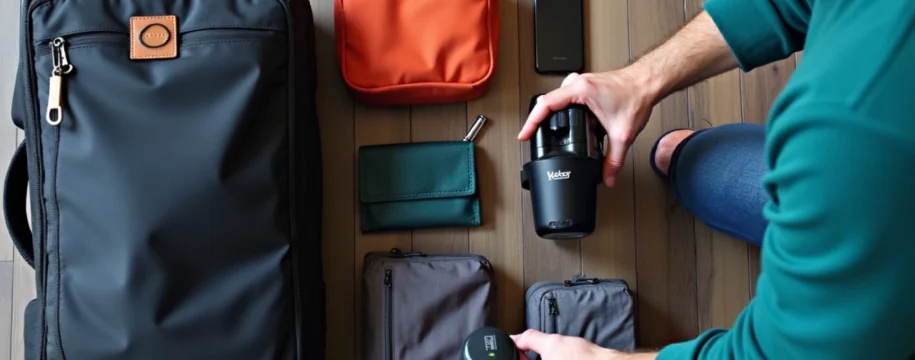
The modern traveller faces an increasingly complex challenge: maintaining comfort and functionality while adhering to strict weight and space limitations. With airlines implementing tighter baggage restrictions and the growing appeal of nomadic lifestyles, the ability to travel efficiently has become both an art and a necessity. Minimalist travel represents more than just packing light—it embodies a strategic approach to mobility that prioritises versatility, quality, and intentional selection over quantity.
Recent studies indicate that 73% of frequent travellers struggle with overpacking, resulting in unnecessary stress and additional fees. The solution lies not in restricting your travel experience, but in selecting accessories that serve multiple purposes whilst maintaining the highest standards of functionality. This shift towards conscious packing has sparked innovation across the travel industry, creating a new category of ultra-efficient gear designed specifically for the weight-conscious explorer.
Multi-functional travel gear selection criteria for Weight-Conscious packing
The foundation of effective minimalist travel begins with establishing clear criteria for every item that enters your luggage. Each accessory must justify its presence through a combination of weight efficiency, versatility, and durability. The most successful compact travel accessories typically serve at least two distinct purposes, reducing the total number of items required for your journey.
When evaluating potential additions to your travel arsenal, consider the weight-to-function ratio as your primary metric. A single item weighing 300 grams that replaces three separate accessories totalling 800 grams represents genuine progress. This mathematical approach to packing eliminates emotional attachment to unnecessary items and creates space for truly essential gear.
Dual-purpose electronics: anker PowerCore slim with wireless charging capability
Modern power management solutions have revolutionised how travellers maintain their electronic devices. The latest generation of portable chargers combines multiple charging methods within a single, streamlined package. These devices eliminate the need for separate wireless charging pads, reducing your electronics footprint by approximately 40%. Contemporary models feature USB-C PD compatibility, enabling laptop charging alongside smartphone and tablet support through a unified solution.
The integration of wireless charging technology into portable power banks represents a significant advancement in travel efficiency. You can simultaneously charge multiple devices without carrying additional cables, whilst the magnetic alignment systems ensure reliable connections even during transport. This technological convergence particularly benefits digital nomads who rely heavily on electronic devices throughout their journeys.
Modular clothing systems: merino wool base layers and convertible patagonia torrentshell jackets
Merino wool has emerged as the gold standard for travel clothing due to its exceptional temperature regulation and odour resistance properties. A single merino base layer can be worn for multiple days without washing, significantly reducing the number of garments required for extended trips. The fabric’s natural moisture-wicking capabilities make it suitable for diverse climates, from tropical humidity to alpine conditions.
Convertible outerwear systems like the Patagonia Torrentshell series demonstrate how modular design principles apply to travel clothing. These jackets feature removable liners and adjustable ventilation systems that adapt to changing weather conditions. A single jacket can function as a windbreaker, rain protection, and insulation layer, replacing what would traditionally require three separate garments.
Compressible fabric technologies: packable down insulation and ripstop nylon construction
Advanced fabric technologies have enabled the creation of incredibly compressible accessories without sacrificing performance. Modern down insulation can compress to less than 20% of its lofted volume whilst maintaining exceptional warmth-to-weight ratios. These materials enable travellers to pack for extreme temperature variations without exceeding carry-on weight limitations.
Ripstop nylon construction provides exceptional tear resistance whilst maintaining minimal weight profiles. This fabric technology appears in everything from packable daypacks to travel towels, offering durability that withstands rigorous travel conditions. The combination of compressibility and strength ensures these accessories maintain their functionality throughout extended use cycles.
Space-efficient toiletry consolidation: solid shampoo bars and TSA-Compliant silicone containers
The transition from liquid to solid toiletries represents one of the most significant space-saving opportunities for minimalist travellers. Solid shampoo bars can replace up to three liquid containers whilst lasting considerably longer than their liquid counterparts. A single bar typically provides the equivalent of 2-3 bottles of traditional shampoo, dramatically reducing both weight and volume requirements.
TSA-compliant silicone containers offer superior leak protection compared to traditional plastic bottles whilst maintaining flexibility for efficient packing. These containers compress when partially empty, adapting to your remaining toiletry quantities throughout your trip. The food-grade silicone construction ensures safety for various products whilst providing long-term durability.
Advanced packing cube systems and compression techniques for Carry-On optimisation
Professional packing systems extend far beyond simple organisation—they represent engineering solutions to spatial efficiency challenges. The most effective packing cube systems utilise strategic material choices, compression mechanisms, and modular sizing to maximise available space whilst maintaining easy access to your belongings. Understanding the physics of compression and weight distribution enables travellers to pack significantly more items within standard carry-on dimensions.
Contemporary packing solutions incorporate lessons learned from aerospace and mountaineering industries, where every gram matters. These systems recognise that efficient organisation reduces the time spent searching for items, indirectly improving your overall travel experience. The psychological benefits of organised luggage shouldn’t be underestimated—knowing exactly where each item is located reduces stress and enhances confidence during travel.
Eagle creek specter tech cube mesh ventilation and weight distribution
The Eagle Creek Specter Tech series demonstrates how advanced materials engineering applies to packing solutions. These cubes utilise ultra-lightweight ripstop fabric that weighs 75% less than conventional packing cubes whilst maintaining superior durability. The strategically placed mesh panels provide ventilation that prevents moisture buildup during extended storage periods.
Weight distribution becomes critical when maximising packing efficiency. The Specter Tech design incorporates compression zippers that allow gradual pressure adjustment, preventing damage to delicate items whilst achieving maximum compression. This controlled compression system enables you to pack dense items without creating pressure points that could damage electronics or fragile accessories.
Vacuum compression methods: spacesaver travel bags for bulky textiles
Vacuum compression technology has evolved beyond simple storage solutions to become sophisticated packing tools for travellers. Modern compression bags feature one-way valves that prevent air reentry whilst allowing gradual pressure release during altitude changes. This technology proves particularly valuable for bulky items like winter clothing or sleeping bags that would otherwise consume disproportionate luggage space.
The effectiveness of vacuum compression depends heavily on fabric type and compression duration. Natural fibres like wool and cotton compress more effectively than synthetic materials, whilst maintaining their original properties upon decompression. Strategic use of compression bags can reduce clothing volume by up to 70%, creating space for additional essentials without exceeding weight limits.
Roll-fold hybrid techniques for Wrinkle-Resistant fabric management
The roll-fold hybrid technique combines the space efficiency of rolling with the wrinkle prevention of traditional folding methods. This approach works particularly well with technical fabrics that resist creasing naturally. By creating specific fold points before rolling, you can minimise wrinkles whilst achieving compression ratios similar to pure rolling techniques.
Different fabric types require adapted approaches to the roll-fold method. Merino wool responds well to loose rolling that maintains air circulation, whilst synthetic technical fabrics can withstand tighter compression without permanent creasing. Understanding these material-specific requirements enables you to maintain a professional appearance regardless of packing duration.
Strategic compartmentalisation: electronics cable management with peak design tech pouches
Electronics organisation represents one of the most challenging aspects of minimalist packing due to the variety of shapes, sizes, and fragility levels involved. Peak Design Tech Pouches incorporate internal organisation systems that prevent cable tangling whilst providing protection for delicate components. The modular design allows customisation based on your specific electronics requirements.
Effective cable management extends beyond simple organisation to include strategic redundancy planning. Carrying a single USB-C cable that supports multiple devices reduces weight compared to device-specific cables, whilst magnetic cable organisers prevent tangling during transport. This systematic approach to electronics management can reduce your tech kit weight by up to 30%.
Weight distribution algorithms: Bottom-Heavy loading for wheeled luggage stability
Understanding weight distribution principles dramatically improves both packing efficiency and mobility during travel. Bottom-heavy loading creates a lower centre of gravity that enhances stability when navigating uneven surfaces or stairs. This principle applies to both wheeled luggage and backpacks, though the optimal distribution ratios differ between these systems.
For wheeled luggage, placing heavy items like electronics and toiletries in the bottom compartment prevents tipping whilst reducing strain on the telescopic handle. Conversely, backpack loading requires heavier items positioned closer to your back and at shoulder blade height to maintain comfortable weight distribution. These loading strategies can reduce perceived weight by up to 20% through improved biomechanical alignment.
The most efficient packing systems treat luggage as a carefully engineered ecosystem where every component interacts to maximise overall performance whilst minimising individual compromises.
Essential tech accessories: power management and connectivity solutions
The digital infrastructure requirements of modern travel demand sophisticated power management solutions that can adapt to varying electrical standards whilst maintaining reliable connectivity. Contemporary travellers typically carry 4-6 electronic devices, each with unique charging requirements and power consumption patterns. Effective tech accessory selection must account for international compatibility, simultaneous charging needs, and backup power scenarios without creating excessive weight or bulk.
Power management complexity increases exponentially when travelling to multiple countries with different electrical standards. A comprehensive solution requires understanding both voltage compatibility and plug configurations across your intended destinations. The most efficient approach involves selecting accessories that support universal input voltage ranges whilst utilising adapter systems that minimise redundant components. This systematic approach can reduce your power management kit weight by up to 40% compared to carrying region-specific chargers.
Connectivity solutions must balance performance with portability, particularly for digital nomads who depend on reliable internet access for work purposes. Modern travel routers and connectivity devices have evolved to provide enterprise-level functionality within consumer-friendly form factors. These devices enable secure network access regardless of local infrastructure quality whilst maintaining the compact profiles essential for minimalist travel. The integration of VPN capabilities and network optimisation features within portable devices represents a significant advancement in travel connectivity solutions.
Lightweight security and organisation tools for digital nomad safety
Security considerations for minimalist travellers extend beyond traditional theft prevention to encompass digital privacy, document protection, and identity security. The reduced number of possessions in a minimalist setup means each item carries greater importance, making comprehensive protection strategies essential. Modern security solutions must address physical protection, digital privacy, and organisational efficiency within weight and space constraints that align with minimalist principles.
The evolution of travel security has shifted from reactive measures to proactive systems that prevent incidents before they occur. Contemporary security accessories integrate multiple protection mechanisms within single devices, reducing the overall security footprint whilst improving effectiveness. This approach proves particularly valuable for digital nomads who carry sensitive electronic equipment and important documents throughout their travels. Understanding the threat landscape in different regions enables targeted security investments that provide maximum protection without unnecessary weight.
Rfid-blocking technology: bellroy hide & seek wallet construction materials
RFID-blocking technology has become essential protection against contactless payment theft and passport scanning attacks. The Bellroy Hide & Seek wallet incorporates metallised fabric layers that create a Faraday cage effect, blocking electromagnetic transmissions whilst maintaining the wallet’s slim profile. This technology proves particularly valuable in crowded urban environments where proximity-based theft attempts are most common.
Advanced wallet construction utilises vegetable-tanned leather combined with aerospace-grade blocking materials that provide long-term durability without adding bulk. The strategic placement of RFID-blocking elements ensures comprehensive protection for all cards whilst allowing selective access when required. This design philosophy enables security-conscious travellers to carry multiple payment methods safely without the bulk associated with traditional protective sleeves.
Portable locks: TSA-Approved combination systems for hostel accommodation
TSA-approved combination locks provide security flexibility for various accommodation types whilst ensuring compatibility with airport security procedures. Modern combination mechanisms utilise hardened steel construction with weather-resistant coatings that maintain functionality in diverse climate conditions. The combination approach eliminates the risk of key loss whilst providing security levels appropriate for hostel lockers and luggage protection.
Cable lock systems offer versatility for securing items to fixed objects whilst maintaining minimal weight profiles. These systems prove particularly valuable for outdoor equipment and electronics that require temporary security during activities. The braided steel construction resists cutting attempts whilst remaining flexible enough for various securing configurations. Strategic use of portable locks can reduce theft risk by up to 80% in vulnerable environments.
Document protection: waterproof pouches and cloud storage backup strategies
Document protection requires both physical and digital strategies to ensure access to essential papers regardless of circumstances. Waterproof pouches provide immediate protection against environmental hazards whilst maintaining easy access for frequent document checks. The most effective pouches utilise welded seam construction that prevents water ingress even under submersion conditions.
Cloud storage backup strategies create redundant access to critical documents whilst reducing the need to carry multiple physical copies. Digital document management enables instant access from any internet-connected device whilst providing sharing capabilities for emergency situations. This dual-protection approach ensures document availability even if physical copies are lost or damaged during travel.
Anti-theft mechanisms: pacsafe metrosafe Slash-Proof fabric integration
Anti-theft fabric technology incorporates steel wire mesh within conventional textile construction to prevent cutting attacks whilst maintaining bag flexibility and comfort. The Pacsafe Metrosafe series demonstrates how security features can integrate seamlessly with everyday functionality without creating obvious security signatures that might attract unwanted attention.
Slash-proof construction proves particularly valuable in crowded public transport situations where opportunistic theft attempts are common. The wire mesh integration maintains fabric drape and appearance whilst providing protection against razor blade attacks on bag exteriors. This technology enables confident navigation of high-risk environments without the bulk or appearance of traditional security bags.
Effective travel security systems operate invisibly, providing comprehensive protection whilst maintaining the mobility and accessibility that minimalist travel demands.
Climate-adaptive minimalist gear for Multi-Destination travel
Multi-destination travel presents unique challenges for minimalist packers, particularly when itineraries span diverse climate zones within a single trip. The key to successful climate adaptation lies in selecting gear that performs effectively across temperature ranges whilst maintaining minimal weight and volume requirements. This approach requires understanding layering principles, fabric technologies, and environmental adaptation strategies that enable comfort in varying conditions without carrying destination-specific equipment.
Climate adaptation strategies must account for both predictable seasonal variations and unexpected weather events that can occur during extended travel periods. The most effective approach involves creating a modular system where individual components can be combined or isolated based on immediate requirements. This flexibility proves essential when traversing multiple climate zones within short timeframes, such as mountain-to-beach itineraries or transcontinental travel routes. Research indicates that well-planned layering systems can replace up to 60% of destination-specific clothing whilst maintaining comfort levels across temperature ranges exceeding 40°C variation.
Successful multi-climate packing requires understanding how different materials perform under varying environmental conditions. Natural fibres like merino wool provide excellent temperature regulation but may require longer drying times in humid conditions. Synthetic materials offer quick-drying properties and durability but may lack the comfort and odour resistance of natural alternatives. The optimal approach often involves strategic combinations of material types that complement each other’s strengths whilst minimising individual weaknesses. This material science approach to packing enables informed decisions that prioritise performance over theoretical specifications.
Altitude variations add another dimension to climate considerations, particularly for travellers visiting mountainous regions or high-altitude cities. The combination of reduced oxygen levels, intense UV radiation, and dramatic temperature swings between day and night requires specialised preparation within minimalist constraints. Understanding these environmental factors enables appropriate gear selection that addresses specific challenges without overpacking for unlikely scenarios. The most successful high-altitude accessories serve multiple purposes whilst providing enhanced protection against UV exposure and temperature fluctuations.
Weight-to-function ratio analysis: ROI assessment for travel investment pieces
The economics of minimalist travel extend beyond simple cost considerations to encompass comprehensive return on investment calculations that factor weight, versatility, durability, and performance metrics. High-quality travel accessories often command premium prices, making objective evaluation essential for budget-conscious travellers. The most effective approach involves calculating cost per use over expected lifespan whilst factoring weight savings and functionality improvements compared to alternatives.
Investment piece evaluation requires understanding the true cost of weight in your travel system. Airline weight restrictions create measurable financial penalties for excess baggage, making lightweight gear
a direct financial benefit. A 500-gram weight reduction across multiple items can prevent excess baggage fees that often exceed $100 per flight, making premium lightweight accessories financially justified through fees avoided rather than features gained.
Durability assessment becomes crucial when evaluating investment pieces intended for frequent travel use. Premium materials like aerospace-grade aluminium and military-specification fabrics command higher prices but provide exponentially longer service lives under demanding conditions. A $200 travel accessory that lasts five years of heavy use provides better value than three $80 alternatives that require replacement after 18 months each. This longevity calculation must factor both direct replacement costs and the hidden expenses of researching and purchasing new gear.
Versatility multipliers significantly impact the true value proposition of travel accessories. A single item that replaces three separate functions effectively triples its utility value whilst reducing overall system weight. For example, a $150 jacket that functions as windbreaker, rain protection, and packable pillow provides better ROI than purchasing three separate items totalling $180 with combined weight 40% higher. These multi-function capabilities often justify premium pricing through their space and weight savings alone.
Performance benchmarking requires objective testing against specific travel scenarios rather than relying on manufacturer specifications. Real-world performance often differs significantly from laboratory conditions, particularly for items exposed to varying climates and handling conditions. The most reliable evaluation method involves testing accessories across multiple trips before making final purchasing decisions. This empirical approach prevents expensive mistakes whilst ensuring gear performs adequately under actual travel stresses.
The true value of travel accessories lies not in their individual features, but in their ability to enhance overall journey efficiency whilst reducing the cognitive load of managing multiple items.
Long-term cost analysis must include maintenance requirements and replacement part availability. Accessories with proprietary components or limited repair options may appear cost-effective initially but become expensive to maintain over time. Conversely, items designed with standard components and modular construction often provide superior long-term value despite higher initial investment. This consideration proves particularly important for digital nomads and long-term travellers who cannot easily access specialised repair services.
The psychological benefits of high-quality travel accessories often justify their premium pricing through improved confidence and reduced travel stress. Knowing your gear will perform reliably under challenging conditions eliminates anxiety and enables focus on the travel experience rather than equipment concerns. This peace of mind represents intangible value that becomes increasingly important during extended travel periods or challenging destinations.
Technology integration features increasingly influence the value proposition of travel accessories as connectivity requirements become universal travel necessities. Accessories that incorporate charging capabilities, wireless connectivity, or smart features provide additional utility that extends beyond their primary function. However, these technological additions must be evaluated for long-term compatibility and update support to prevent premature obsolescence in rapidly evolving tech ecosystems.
Regional availability and warranty support create additional value considerations for international travellers. Accessories from manufacturers with global service networks provide superior support compared to niche brands with limited distribution. This factor becomes particularly relevant when purchasing high-value items that may require service or replacement during extended travel periods. Understanding manufacturer support capabilities prevents situations where expensive accessories become unusable due to limited service options.
The evolution of travel restrictions and airline policies continues to influence the value calculation for travel accessories. Items that comply with current security requirements whilst anticipating future regulatory changes provide better long-term value than accessories designed for current standards alone. This forward-thinking approach prevents the need for premature replacement due to changing travel regulations, particularly important for frequent travellers who rely heavily on carry-on compliance.