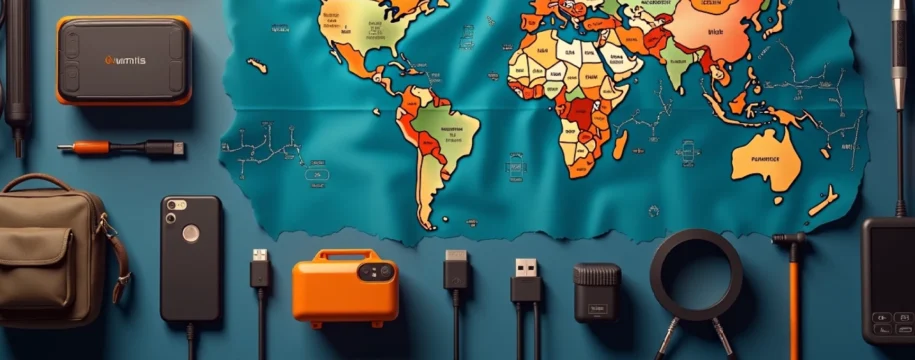
Modern international travel demands sophisticated technological preparation that extends far beyond simply packing a smartphone and charger. Today’s global nomads, business travellers, and adventure seekers require comprehensive tech ecosystems capable of functioning seamlessly across diverse electrical standards, communication networks, and regulatory environments. The challenge lies not merely in selecting portable devices, but in creating an integrated technological framework that maintains operational excellence whether you’re navigating the bustling streets of Tokyo, conducting business meetings in Lagos, or exploring remote wilderness areas in Patagonia.
The complexities of international travel technology have evolved dramatically as our dependence on digital connectivity has intensified. From varying voltage standards and plug configurations to regional internet restrictions and climate-specific hardware challenges, travellers must now consider numerous technical variables that previous generations never encountered. Building an adaptable travel tech kit requires strategic thinking , understanding of global infrastructure variations, and investment in versatile equipment that performs reliably across multiple scenarios and environments.
Universal power solutions for Multi-Regional travel electronics
Power management represents the foundational element of any international travel technology kit, as electrical infrastructure varies significantly across global regions. The complexity extends beyond simple plug adapters to encompass voltage differences, frequency variations, and power delivery standards that can damage sensitive electronics if not properly addressed. Understanding these variations becomes crucial when travelling between countries like the United States (120V, 60Hz) and European nations (230V, 50Hz), where improper connections could result in equipment failure or safety hazards.
Modern power solutions must accommodate not only traditional AC power requirements but also the increasing prevalence of USB-powered devices and fast-charging protocols. The proliferation of USB Power Delivery standards has revolutionised portable electronics, enabling everything from smartphones to laptops to charge through standardised connectors. However, implementing these solutions effectively requires understanding of wattage requirements, cable specifications, and device compatibility matrices that vary between manufacturers and regions.
Multi-standard USB-C PD chargers with GaN technology integration
Gallium Nitride (GaN) technology has transformed portable charging solutions by enabling significantly higher power density in smaller form factors. These advanced chargers can deliver up to 100 watts of power through USB-C Power Delivery protocols while maintaining compact dimensions suitable for travel applications. GaN chargers typically weigh 40-50% less than traditional silicon-based alternatives while generating less heat and offering superior efficiency ratings approaching 95% under optimal conditions.
Multi-port GaN chargers equipped with intelligent power distribution can simultaneously charge laptops, tablets, and smartphones through dynamic wattage allocation. These devices automatically detect connected equipment and adjust power delivery accordingly, preventing overcharging while optimising charging speed. Premium models feature programmable profiles for specific device combinations, ensuring optimal performance whether you’re charging a MacBook Pro alongside an iPhone or powering multiple Android devices with varying power requirements.
Type G to universal plug adapters for commonwealth nations
Commonwealth countries predominantly utilise Type G electrical outlets, characterised by their distinctive three-pin design with rectangular prongs and integrated fuse protection. These outlets, standard across the United Kingdom, Ireland, Malaysia, Singapore, and numerous other nations, require specific adapter configurations that accommodate both the physical plug geometry and electrical specifications. Quality Type G adapters must support current ratings up to 13 amperes while maintaining proper earthing connections for safety compliance.
Universal adapters designed for Commonwealth markets often incorporate sliding mechanisms that reconfigure pin arrangements for different regional standards. These adapters should feature built-in surge protection, LED indicators for proper connection verification, and compact folding designs that minimise travel bag space requirements. Professional-grade adapters include replaceable fuses and certification marks indicating compliance with relevant electrical safety standards in destination countries.
Portable power banks with TSA-Compliant 100wh capacity ratings
Transportation Security Administration regulations limit lithium-ion battery capacity to 100 watt-hours for carry-on baggage, establishing a critical constraint for travel power bank selection. This limitation translates to approximately 27,000mAh capacity at 3.7V nominal voltage, representing the maximum portable power storage permitted on commercial aircraft. Strategic power bank selection must balance capacity constraints with practical charging requirements for extended travel periods without reliable electrical access.
High-capacity power banks within TSA limitations now incorporate multiple output protocols including USB-A Quick Charge, USB-C Power Delivery, and wireless charging capabilities. Advanced models feature digital displays showing remaining capacity, output wattage, and estimated charging times for connected devices. Some units include pass-through charging functionality, allowing simultaneous charging of the power bank and connected devices when AC power becomes available, effectively serving as uninterruptible power supplies for critical equipment.
Solar panel integration for Off-Grid destinations like patagonia
Remote travel destinations often lack reliable electrical infrastructure, necessitating alternative power generation solutions for extended expeditions. Portable solar panels designed for travel applications utilise monocrystalline silicon cells offering efficiency ratings between 22-24% under optimal sunlight conditions. These panels fold into compact configurations for transport while deploying to capture maximum solar energy during daylight hours, providing sustainable power generation capabilities in locations where conventional charging proves impossible.
Modern travel solar panels incorporate maximum power point tracking technology that optimises energy harvest across varying light conditions and panel orientations. Integrated charge controllers prevent overcharging of connected devices while providing stable power output despite fluctuating solar irradiance. Quality solar panels include weather-resistant construction rated for outdoor exposure and multiple output options including USB-A, USB-C, and DC barrel connectors for compatibility with diverse electronic equipment.
Communication technology stack for global connectivity
Global communication requirements have evolved beyond simple voice and text messaging to encompass high-bandwidth data applications, video conferencing, and real-time collaboration tools essential for modern business and personal connectivity. International travellers must navigate complex networks of cellular providers, internet restrictions, and coverage limitations while maintaining consistent access to critical communication services. The challenge becomes particularly acute in regions with limited infrastructure development or countries implementing internet censorship and content filtering systems.
Building resilient communication capabilities requires layered redundancy incorporating multiple technologies and service providers. This approach ensures connectivity maintenance even when primary communication channels experience disruption due to network failures, political restrictions, or geographical limitations. Professional travellers often implement communication hierarchies progressing from preferred high-speed options to emergency backup systems capable of functioning in extreme scenarios.
Dual-sim 5G smartphones with eSIM capability configuration
Contemporary smartphones featuring dual-SIM functionality combined with embedded SIM (eSIM) technology provide unprecedented flexibility for international communication management. These devices enable simultaneous operation of home country services alongside local carrier connections, allowing travellers to maintain existing phone numbers while accessing affordable local data and voice services. eSIM technology eliminates physical SIM card dependencies , enabling rapid carrier switching through software configuration without requiring local SIM card purchases or installation procedures.
Advanced dual-SIM implementations support intelligent network switching based on signal strength, data costs, and service quality parameters. Users can configure automatic failover between carriers, ensuring continuous connectivity even when primary networks experience disruption. Premium devices offer carrier aggregation capabilities that combine multiple network connections for enhanced bandwidth and reliability, particularly valuable in areas with inconsistent coverage or during high-demand periods.
Satellite communication devices: garmin inreach vs iridium solutions
Satellite communication devices provide essential connectivity for travel to remote areas beyond terrestrial cellular coverage, offering text messaging, GPS tracking, and emergency communication capabilities through global satellite networks. Garmin inReach devices utilise the Iridium satellite constellation for worldwide coverage, featuring two-way messaging, weather updates, and SOS emergency beacon functionality. These devices typically offer 50+ hour battery life and integrate with smartphone applications for enhanced messaging capabilities and navigation features.
Dedicated Iridium satellite phones provide more comprehensive voice communication capabilities but require larger form factors and higher operational costs. These devices offer reliable voice quality and global coverage excluding polar regions, making them suitable for professional applications requiring consistent communication capabilities. Satellite communication costs vary significantly between messaging-only devices and full voice solutions , with monthly service plans ranging from £15 for basic messaging to over £100 for unlimited voice services.
Vpn-enabled mobile hotspots for restricted networks in china
Countries implementing internet censorship and content filtering require specialised connectivity solutions to maintain access to restricted services and websites. VPN-enabled mobile hotspots provide encrypted tunnelling capabilities that bypass geographical restrictions while sharing internet connections across multiple devices. These devices incorporate hardware-level VPN processing that maintains connection security without degrading performance on connected smartphones, laptops, and tablets.
Professional-grade mobile hotspots feature enterprise VPN protocols including WireGuard, OpenVPN, and IKEv2 with automatic server switching capabilities for optimal performance and security. Advanced models include kill switch functionality that terminates internet access if VPN connections fail, preventing accidental exposure of restricted traffic. Battery life typically ranges from 8-12 hours of continuous operation with support for up to 32 simultaneous device connections depending on bandwidth requirements and network conditions.
Mesh networking devices for remote area communication backup
Mesh networking technology enables device-to-device communication without requiring central infrastructure, creating resilient communication networks in areas lacking traditional connectivity. Portable mesh devices establish ad-hoc networks spanning several kilometres, allowing text messaging, file sharing, and basic internet access through any connected device with external connectivity. These systems prove particularly valuable for group travel in remote areas where maintaining communication between team members becomes critical for safety and coordination.
Modern mesh devices utilise long-range radio protocols including LoRa and frequency-hopping spread spectrum technologies for extended range and interference resistance. Battery-powered nodes can operate for weeks on single charges while providing continuous network connectivity for connected devices. Mesh networks automatically reconfigure routing paths when individual nodes fail or move beyond communication range, maintaining network integrity even as network topology changes dynamically.
Navigation and mapping hardware for diverse terrains
Navigation technology for international travel extends far beyond smartphone GPS applications to encompass specialised hardware designed for challenging environments and diverse geographical conditions. Professional navigation requirements often demand precise positioning accuracy, extended battery life, and resilient construction capable of withstanding extreme weather conditions and physical impacts. The limitations of smartphone-based navigation become apparent in areas with limited satellite visibility, extreme temperatures, or when battery conservation becomes critical for emergency situations.
Dedicated GPS devices offer significant advantages including enhanced satellite reception capabilities, detailed topographic mapping, and robust construction designed for outdoor applications. These devices typically feature days or weeks of battery life compared to hours for smartphone GPS applications, while providing superior accuracy and reliability in challenging conditions. Professional navigation devices often incorporate multiple satellite constellation support including GPS, GLONASS, Galileo, and BeiDou systems for enhanced positioning accuracy and availability in diverse global regions.
Modern GPS units designed for international travel feature worldwide base maps with the capability to load detailed regional charts for specific destinations. These devices support waypoint navigation, route planning, and breadcrumb trail recording for retracing paths in unfamiliar terrain. Advanced models include barometric altimeters, electronic compasses, and wireless connectivity for sharing location data with emergency contacts or team members. Weather-resistant construction with IPX7 or higher ratings ensures reliable operation in rain, snow, and humid conditions commonly encountered during international travel.
Backup navigation systems remain essential even when primary GPS devices function reliably, as electronic failures can occur in critical situations. Traditional compass and map combinations provide technology-independent navigation capabilities, while smartphone applications with offline mapping offer intermediate backup options. Downloaded offline maps should encompass entire travel regions with sufficient detail for pedestrian navigation , as internet connectivity for map downloads may prove unreliable or expensive in remote international destinations.
Data storage and security architecture for international travel
International travel presents unique data security challenges requiring comprehensive protection strategies that address both digital and physical threats. Travellers routinely cross borders where electronic devices may undergo inspection, connect to untrusted networks, and face increased risks of theft or loss. Professional data protection requires layered security approaches incorporating encryption, access controls, and backup systems designed to maintain data integrity while enabling legitimate access throughout travel periods.
Border crossing procedures increasingly involve electronic device searches that may compromise sensitive personal and business information. Effective security architectures must balance accessibility requirements with protection against unauthorised access , implementing encryption and authentication systems that protect data without creating insurmountable barriers for legitimate users. Cloud-based storage solutions provide additional protection by maintaining data copies in secure locations while enabling remote access from any location with internet connectivity.
Hardware-encrypted SSDs with AES-256 Military-Grade protection
Hardware-encrypted solid-state drives implement cryptographic processing independent of host computer systems, providing protection that remains effective even if computers become compromised by malware or physical tampering. AES-256 encryption offers security levels approved for protecting classified military information, ensuring that stored data remains protected against sophisticated attack methods. These drives automatically encrypt all stored data without requiring user intervention while maintaining performance levels equivalent to unencrypted storage devices.
Self-encrypting drives feature built-in authentication systems requiring PIN codes, biometric verification, or hardware tokens for access authorisation. Advanced models include tamper detection mechanisms that automatically destroy encryption keys if physical intrusion attempts are detected. Hardware encryption operates independently of operating systems , providing protection that remains effective regardless of software vulnerabilities or malware infections that might compromise computer security systems.
Multi-cloud synchronisation systems across regional servers
Geographic data distribution through multiple cloud providers ensures data availability even when individual services experience disruption or regional access restrictions. Multi-cloud architectures typically span providers including Amazon Web Services, Microsoft Azure, Google Cloud Platform, and regional alternatives to minimise risks associated with single-provider dependencies. Automated synchronisation maintains data consistency across platforms while providing redundancy against service failures or political restrictions affecting specific providers.
Regional server distribution becomes particularly important when travelling to countries implementing internet content filtering or restrictions on specific cloud service providers. Data synchronisation systems should incorporate conflict resolution mechanisms for handling simultaneous modifications across multiple platforms while maintaining data integrity. Advanced implementations include versioning systems that preserve historical data states, enabling recovery from corruption or accidental modifications that might occur during travel periods.
Rfid-blocking technology integration in digital wallet systems
Radio Frequency Identification (RFID) technology embedded in modern payment cards, passports, and identification documents creates vulnerability to unauthorised scanning and data theft. RFID-blocking materials incorporated into wallets, document holders, and travel bags prevent electromagnetic communication between embedded chips and scanning devices. Quality RFID blocking utilises metallic mesh or conductive fabric construction that creates Faraday cage effects, completely isolating protected items from radio frequency signals.
Digital wallet integration combines RFID protection with organisation systems designed for international travel documents and payment methods. These systems typically include dedicated slots for passports, multiple currency compartments, and secure storage for backup payment cards and emergency documentation. Advanced models incorporate GPS tracking capabilities and mobile application integration for location monitoring and loss prevention, providing additional security layers for critical travel documents.
Biometric authentication devices for secure access control
Portable biometric authentication devices provide secure access control for sensitive data without relying on passwords or PINs that might be compromised through observation or coercion. Fingerprint scanners, iris recognition systems, and facial recognition devices offer authentication methods that cannot be easily duplicated or stolen. These devices typically integrate with laptops, smartphones, and storage systems to provide multi-factor authentication enhancing security beyond traditional password-based systems.
USB-connected biometric devices enable secure authentication on any computer system, providing consistent security regardless of host computer configurations. Advanced models include encrypted storage for biometric templates, ensuring that authentication data remains protected even if devices are physically compromised. Battery-powered biometric devices function independently of host computer power , maintaining authentication capabilities even during extended use periods without charging opportunities.
Climate-adaptive hardware protection systems
International travel exposes electronic equipment to diverse environmental conditions ranging from tropical humidity and desert heat to arctic cold and high-altitude atmospheric pressure variations. Traditional consumer electronics often lack adequate protection against these extreme conditions, requiring additional protective measures to ensure reliable operation throughout diverse climate zones. Temperature fluctuations particularly affect battery performance, screen visibility, and internal component stability, necessitating specialised protection and operational strategies for sensitive equipment.
Humidity represents one of the most significant threats to electronic equipment, as moisture infiltration can cause corrosion, short circuits, and permanent damage to sensitive components. Tropical destinations with humidity levels exceeding 90% require active moisture protection through desiccant systems, sealed storage containers, and climate-controlled transportation methods. Condensation formation during rapid temperature transitions poses additional risks , particularly when moving equipment between air-conditioned environments and outdoor conditions in hot, humid climates.
Protective systems for extreme climate travel typically incorporate multiple protection layers including waterproof cases, thermal insulation, and shock-absorbing materials. Pelican cases and similar hard-shell containers provide military-grade protection against impacts, water intrusion, and temperature extremes while maintaining precise environmental controls through pressure equalisation valves and humidity indicators. Soft-shell alternatives offer improved portability while providing adequate protection for less extreme conditions, featuring weather-resistant zippers, padded compartments, and modular organisation systems.
Thermal management becomes crucial when travelling through regions with extreme temperature variations, as electronic components typically operate within narrow temperature ranges for optimal performance. Lithium-ion batteries experience reduced capacity in cold conditions while facing thermal runaway risks in excessive heat, requiring temperature monitoring and protection systems. Advanced protective cases incorporate phase-change materials that absorb and release thermal energy, maintaining stable internal temperatures despite external climate fluctuations.
Altitude-related atmospheric pressure changes affect sealed electronic devices, potentially causing screen separation or internal component stress during rapid elevation changes. Professional travel cases feature pressure equalisation systems with semi-permeable membranes that allow gradual pressure adjustment while maintaining moisture protection. Quality protective systems include integrated humidity sensors and temperature logging capabilities for monitoring environmental exposure and identifying potential equipment stress before failures occur.
Regional compatibility matrix for electronic standards
Global travel requires comprehensive understanding of regional variations in electronic standards, communication protocols, and regulatory requirements that affect device functionality and legal compliance. These variations extend beyond simple power requirements to encompass radio frequency regulations, import restrictions, and certification requirements that vary significantly between countries and regions. Professional travellers must navigate complex matrices of compatibility requirements while ensuring their equipment operates legally and effectively in diverse regulatory environments.
Frequency band allocations for cellular communication, WiFi, and Bluetooth vary between regions due to different regulatory frameworks and spectrum licensing approaches. Devices certified for operation in North America may face restrictions in European or Asian markets due to different frequency assignments and power output limitations. Tri-band and quad-band devices provide broader compatibility but may still encounter limitations in specific countries implementing unique frequency allocations or power restrictions for consumer electronics.
Import regulations for electronic devices vary significantly between countries, with some nations requiring specific certifications or imposing restrictions on encryption capabilities and radio transmission power. Professional equipment often faces additional scrutiny at border crossings, particularly devices capable of radio transmission or data encryption that might be considered security sensitive. Understanding destination country requirements before travel prevents potential confiscation or legal complications that could disrupt business activities or personal travel plans.
Certification requirements including CE marking for European markets, FCC compliance for United States operation, and IC certification for Canadian use ensure device safety and electromagnetic compatibility within regulatory frameworks. Devices lacking appropriate certifications may face operational restrictions or legal penalties in certain jurisdictions. Professional travellers should verify certification compliance for all electronic equipment before international travel to avoid potential regulatory violations or equipment confiscation during border inspections.
Regional network standards for cellular communication include GSM, CDMA, LTE, and 5G implementations that vary in frequency bands, modulation schemes, and carrier compatibility between different geographical areas. Devices optimised for specific regional standards may experience reduced performance or complete incompatibility when used in areas implementing different network technologies. Understanding carrier compatibility and network coverage maps becomes essential for maintaining reliable communication services throughout international travel itineraries.
Power delivery standards beyond basic voltage and frequency requirements include USB Power Delivery profiles, Quick Charge implementations, and proprietary charging protocols that may not function consistently across different regional markets. Wall adapters and charging equipment certified for specific regions may lack compatibility with devices designed for alternative markets, requiring careful selection of universal charging solutions that support multiple standards and regional requirements.
The integration of these diverse compatibility requirements demands systematic approach to equipment selection and configuration management. Creating comprehensive compatibility matrices that map device capabilities against destination requirements enables informed decision-making for equipment selection and travel preparation. Professional travellers benefit from maintaining detailed equipment inventories that document certification status, frequency band support, and regional compatibility for all electronic devices included in travel technology kits.
Emerging technologies including 5G networks, WiFi 6E implementations, and advanced satellite communication systems continue evolving regional compatibility requirements as different countries adopt new standards at varying rates. Staying informed about technological developments and regulatory changes in destination countries ensures continued equipment compatibility and optimal performance throughout international travel experiences. Regular equipment updates and compatibility verification prevent obsolescence while maintaining access to advanced communication and productivity technologies in diverse global markets.