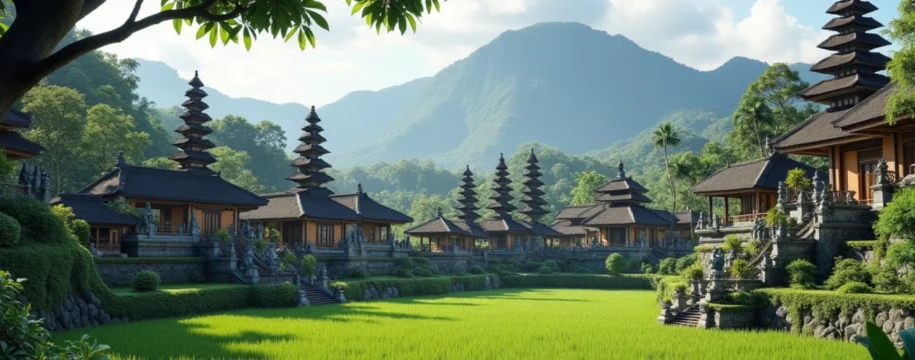
Beneath Bali’s reputation as a tropical paradise lies a profound cultural landscape that extends far beyond Instagram-worthy beach clubs and luxury resorts. The island harbours archaeological treasures spanning over a millennium, indigenous communities preserving pre-Hindu traditions, and artisan villages where ancient crafts continue to flourish through generations of dedicated practitioners. From the mystical temple complexes carved into volcanic rock to the intricate double ikat textiles woven exclusively in traditional villages, Bali’s authentic cultural heritage offers extraordinary depth for those willing to venture beyond the conventional tourist circuit.
This cultural richness stems from Bali’s unique position as the last Hindu stronghold in predominantly Muslim Indonesia, combined with its remarkable ability to preserve indigenous Bali Aga traditions that predate Hindu influence entirely. The island’s sophisticated irrigation systems, recognised by UNESCO for their thousand-year-old engineering excellence, continue to sustain both agricultural communities and cultural practices that have remained largely unchanged for centuries. Understanding these hidden gems requires appreciating how Balinese society has maintained its spiritual and artistic traditions whilst adapting to modern pressures.
Sacred temple complexes beyond besakih: architectural marvels and ritual significance
While Besakih Temple commands attention as Bali’s “Mother Temple,” the island’s spiritual landscape encompasses numerous sacred complexes that showcase extraordinary architectural innovation and profound religious significance. These temples demonstrate sophisticated engineering techniques developed over centuries, often incorporating natural geological features into their design whilst serving as centres for elaborate ceremonial practices that continue to define Balinese Hindu spirituality.
Pura lempuyang luhur: eastern peninsula’s ancient hillside sanctuary
Perched dramatically on the slopes of Mount Lempuyang at an elevation exceeding 1,700 metres, Pura Lempuyang Luhur represents one of Bali’s most significant directional temples, serving as the island’s eastern guardian. The complex comprises seven distinct temple levels, each requiring pilgrims to ascend through increasingly challenging terrain that tests both physical endurance and spiritual commitment. The temple’s strategic positioning offers unobstructed views across eastern Bali towards the sacred Mount Agung, creating a visual axis that reinforces the temple’s role in maintaining cosmic balance.
The architectural elements at Lempuyang showcase classical Balinese design principles, with the famous “Gates of Heaven” serving both practical and symbolic functions. These split gates, or candi bentar , create dramatic frames for ceremonial processions whilst representing the Hindu concept of duality that must be transcended to achieve spiritual unity. Recent archaeological surveys have revealed evidence suggesting the site has maintained continuous religious significance for over eight centuries, making it among Bali’s oldest active temple complexes.
Goa gajah archaeological site: 11th century Rock-Cut temple engineering
The Elephant Cave archaeological complex demonstrates remarkable 11th-century engineering prowess through its intricate rock-cut architecture carved directly into natural cliff faces. Archaeological evidence suggests the site served multiple religious communities, with Hindu shrines, Buddhist stupas, and meditation chambers coexisting within the same compound, reflecting Bali’s historically syncretic religious practices. The cave entrance features an elaborate demon face carving that functions as both decorative element and spiritual portal, designed to frighten away evil spirits whilst welcoming devotees.
Inside the cave, multiple chambers reveal sophisticated drainage systems and ventilation shafts that maintain stable temperature and humidity levels essential for preservation of ancient artefacts. The adjacent holy spring pools, fed by underground aquifers, continue to provide sacred water for purification ceremonies, demonstrating the builders’ understanding of hydrology and sacred geography. Recent restoration work has uncovered additional chambers and revealed the complex’s original extent, which encompasses several hectares of carefully planned religious and residential spaces.
Pura ulun danu batur: crater lake temple complex and water goddess worship
Situated on the rim of Mount Batur’s ancient caldera, Pura Ulun Danu Batur serves as the primary temple dedicated to Dewi Danu, the goddess governing all freshwater sources throughout Bali. The temple’s positioning overlooking the crater lake demonstrates sophisticated understanding of volcanic hydrology, as the lake serves as a crucial water source for the island’s irrigation systems. The complex features multiple courtyards arranged according to traditional Balinese spatial principles, with each level serving specific ceremonial functions related to agricultural cycles and water management.
The temple’s annual Odalan festival attracts thousands of devotees who participate in elaborate ceremonies involving offerings of agricultural products, symbolic of the relationship between spiritual practice and environmental stewardship. The temple’s collection of sacred objects includes ancient bronze ceremonial vessels and rare palm-leaf manuscripts containing detailed irrigation schedules that coordinate farming activities across multiple river valleys. These documents represent invaluable records of traditional ecological knowledge that continues to inform contemporary water management practices.
Gunung kawi temple tombs: royal candi rock carvings of tampaksiring
The Gunung Kawi complex showcases the pinnacle of 11th-century royal mortuary architecture through ten monumental candi carved directly into cliff faces along the sacred Pakerisan River valley. These shrines, each standing approximately eight metres tall, commemorate members of the Udayana dynasty and demonstrate sophisticated understanding of both architectural engineering and sacred geometry. The carvings required removing hundreds of tonnes of volcanic stone whilst maintaining structural integrity of the surrounding cliff face, representing an extraordinary feat of medieval engineering.
Archaeological investigations have revealed extensive hermitage caves surrounding the main monuments, suggesting the site functioned as a major monastic centre supporting dozens of religious practitioners. The complex includes elaborate water features channelling sacred river water through carved basins and pools designed for purification rituals. Recent discoveries of bronze inscriptions and ceramic fragments indicate the site maintained international connections, with artefacts showing influences from Java, India, and possibly China, demonstrating Bali’s integration into broader Southeast Asian cultural networks.
Traditional balinese craft villages: artisan techniques and cultural preservation
Bali’s artisan villages represent living museums where traditional craft techniques continue to evolve whilst maintaining essential cultural authenticity. These communities have preserved specialised knowledge systems passed down through family lineages spanning numerous generations, creating distinct regional identities based on specific materials and techniques. The economic significance of these crafts extends beyond tourism, providing sustainable livelihoods for thousands of families whilst maintaining cultural practices that define Balinese identity.
Celuk silver filigree mastery: granulation and Wire-Drawing methods
Celuk village has established international recognition for its sophisticated silver filigree techniques, which combine ancient granulation methods with contemporary design innovations. Master craftsmen employ traditional tools including bamboo blow pipes and coconut shell charcoal forges to create intricate jewellery featuring microscopic silver balls soldered into complex geometric patterns. The granulation technique, requiring precise temperature control and timing, produces decorative surfaces that shimmer with extraordinary complexity whilst maintaining structural durability essential for functional jewellery.
The village operates through extended family workshops where knowledge transmission follows strict traditional protocols, with apprentices spending years mastering basic wire-drawing techniques before advancing to complex assembly methods. Contemporary Celuk artisans have successfully adapted traditional patterns to modern market demands whilst preserving essential technical knowledge, creating hybrid designs that maintain cultural authenticity whilst appealing to international collectors. The economic success of Celuk’s silver industry has enabled significant infrastructure development whilst supporting traditional educational systems that ensure continuity of craft knowledge.
Mas village wood carving: hibiscus and crocodile wood sculpting traditions
Mas village represents Bali’s premier wood carving centre, where artisans work primarily with hibiscus ( pule ) and crocodile wood ( pules ) to create sculptures ranging from traditional Hindu deities to contemporary artistic expressions. The village’s carving traditions trace back to the 15th century, when royal patronage supported workshops producing elaborate temple decorations and ceremonial objects. Master carvers employ tools largely unchanged for centuries, including traditional chisels and gouges crafted from high-carbon steel and bamboo handles.
The carving process begins with careful wood selection, as different species require specific techniques and offer varying characteristics in terms of grain pattern, hardness, and spiritual significance. Pule wood, considered sacred in Balinese tradition, is reserved for religious sculptures and requires special purification ceremonies before carving begins. Contemporary Mas carvers have expanded beyond traditional religious themes to create innovative artistic works whilst maintaining technical standards established by generations of master craftsmen, ensuring the tradition’s continued vitality and economic viability.
Tenganan pegringsingan: double ikat geringsing textile weaving
Tenganan Pegringsingan village maintains exclusive mastery of geringsing double ikat weaving, a technique so complex that it exists nowhere else in Indonesia and only rarely worldwide. The process involves binding and dyeing both warp and weft threads before weaving, requiring mathematical precision to ensure pattern alignment in the finished textile. Master weavers spend months calculating thread placement and colour sequences, with the most complex pieces requiring over a year to complete. The resulting textiles feature intricate geometric patterns that hold deep spiritual significance in Balinese Hindu cosmology.
The village operates under traditional awig-awig laws that restrict geringsing production to local residents and mandate specific ritual protocols throughout the weaving process. Natural dyes derived from indigenous plants, including mengkudu roots and tarum leaves, create the characteristic red and black colour palette that distinguishes authentic geringsing from imitations. The textiles serve essential roles in important ceremonies, particularly weddings and temple festivals, where they provide spiritual protection and demonstrate the owner’s cultural sophistication.
Sukawati traditional market: palm leaf manuscript and ceremonial craft production
Sukawati’s traditional market functions as a vital centre for ceremonial craft production, where artisans create the elaborate offerings and decorative elements essential for Balinese religious practices. The market specialises in lontar palm leaf manuscripts, carved with traditional metal styluses and inscribed with sacred texts, historical records, and astrological calculations. Master scribes require decades of training to master the complex scripts and acquire the religious knowledge necessary for creating authentic ceremonial texts.
Beyond manuscripts, Sukawati artisans produce thousands of ceremonial items including carved coconut shell decorations, bamboo temple ornaments, and intricate flower arrangements that form integral components of daily religious observances. The market operates according to traditional calendar systems, with production cycles coordinated to meet demand for major religious festivals. This seasonal rhythm maintains direct connections between craft production and spiritual practice, ensuring artisans remain engaged with the cultural contexts that give their work meaning and authenticity.
Subak agricultural heritage: UNESCO-Recognised rice terrace management systems
The subak irrigation system represents one of the world’s most sophisticated traditional agricultural management systems, earning UNESCO recognition for its outstanding cultural and environmental significance. These cooperative irrigation societies, some dating back over a thousand years, demonstrate remarkable integration of practical water management with spiritual practices, social organisation, and ecological conservation. The system encompasses not merely physical infrastructure but complex social institutions that coordinate farming activities across entire watersheds whilst maintaining religious observances essential to Balinese agricultural success.
Each subak operates through democratic principles that predate modern governance systems, with elected leaders coordinating planting schedules, water allocation, and maintenance responsibilities among member farmers. The timing of agricultural activities follows traditional calendars that synchronise with religious festivals, ensuring that farming practices maintain spiritual significance whilst optimising practical outcomes. This integration creates resilient agricultural systems capable of adapting to environmental variations whilst preserving biodiversity through traditional crop rotation and integrated pest management techniques.
Traditional subak systems achieve remarkable productivity levels whilst maintaining environmental sustainability, demonstrating how indigenous knowledge systems can provide models for contemporary agricultural challenges including climate change adaptation and food security.
The physical infrastructure of subak systems includes elaborate networks of channels, tunnels, and distribution gates that manage water flow with extraordinary precision. Master engineers, known as ulu arah , possess detailed knowledge of hydraulic principles that enable them to design systems capable of delivering exact water volumes to individual rice plots across vast terraced landscapes. Recent engineering analyses have revealed that traditional subak designs achieve efficiency levels comparable to modern irrigation systems whilst requiring minimal external inputs and maintaining ecological balance through integrated aquaculture and livestock management.
The cultural dimensions of subak systems extend far beyond agricultural production to encompass elaborate ceremonial cycles that strengthen community bonds whilst ensuring environmental stewardship. Temple complexes associated with each subak serve as centres for coordination meetings, conflict resolution, and religious observances that maintain the spiritual foundations underlying successful cooperation. These institutions have demonstrated remarkable resilience, adapting to political changes, economic pressures, and technological innovations whilst preserving essential cultural values that continue to define rural Balinese communities.
Indigenous bali aga communities: Pre-Hindu cultural practices and village governance
The Bali Aga people represent Bali’s original inhabitants, maintaining distinct cultural traditions that predate Hindu influence and offer fascinating insights into pre-contact Southeast Asian societies. These communities, concentrated in mountainous regions including Tenganan, Trunyan, and Sembiran, preserve governance systems, architectural styles, and ceremonial practices that differ significantly from mainstream Balinese Hindu culture. Their traditional laws, known as awig-awig , create sophisticated social institutions that regulate everything from marriage customs to land use whilst maintaining ecological balance and cultural continuity.
Bali Aga villages operate through consensus-based decision-making processes that involve all adult community members in important deliberations. These democratic traditions, refined over centuries, create remarkably egalitarian societies where leadership rotates among qualified individuals and decisions require broad community support. The villages maintain strict territorial boundaries and marriage customs that preserve genetic and cultural distinctiveness whilst engaging selectively with external economic opportunities and modern technologies.
Trunyan village funeral customs: taru menyan tree death rituals
Trunyan village, situated on the shores of Lake Batur, maintains unique burial practices centred around the sacred taru menyan tree, whose natural fragrance neutralises decomposition odours and enables open-air corpse exposure. The village operates three distinct burial grounds: one for natural deaths, another for accidents or suicides, and a third for children and unmarried individuals. Bodies are placed in bamboo cages beneath the ancient tree, where natural decomposition processes return remains to the earth without creating health hazards or unpleasant odours for the community.
These practices reflect sophisticated understanding of environmental health and spiritual ecology that enables sustainable mortuary customs in challenging geographic conditions. The taru menyan tree, found nowhere else in Bali, requires specific soil and climatic conditions that limit this burial practice to Trunyan’s unique location. Village elders maintain detailed knowledge of proper procedures, timing, and ritual requirements that ensure both spiritual and practical effectiveness of their traditional mortuary system.
Tenganan bali aga calendar system: sasih traditional lunar calculations
Tenganan village operates according to ancient lunar calendar systems that differ significantly from both Balinese Hindu and Javanese calendars used elsewhere on the island. Their traditional sasih system coordinates agricultural activities, ceremonial observances, and social events according to precise astronomical calculations maintained by village astronomers who inherit specialized mathematical knowledge. These calendar systems demonstrate sophisticated understanding of celestial mechanics and seasonal cycles essential for successful agricultural planning in tropical environments.
The village’s calendar specialists, known as jero gede , maintain palm-leaf manuscripts containing detailed astronomical calculations, weather prediction methods, and optimal timing for various activities. This traditional knowledge enables remarkable precision in predicting seasonal variations, monsoon patterns, and optimal planting dates that contribute to agricultural success whilst coordinating community activities according to spiritual requirements. The calendar system continues to guide daily life in Tenganan, demonstrating the practical value of traditional knowledge systems in contemporary contexts.
Sembiran archaeological findings: bronze age settlement evidence
Archaeological excavations in Sembiran village have revealed evidence of continuous occupation spanning over two millennia, making it one of Southeast Asia’s longest continuously inhabited sites. Bronze Age artefacts, including sophisticated metal tools and decorative objects, demonstrate advanced metallurgical knowledge and extensive trade connections with mainland Southeast Asia, India, and possibly China. These findings suggest that Bali Aga communities participated in complex regional trade networks whilst maintaining distinct cultural identities.
Recent discoveries include ceramic fragments showing influences from multiple cultural traditions, indicating that early Bali Aga societies successfully integrated external innovations whilst preserving indigenous practices. The archaeological evidence suggests continuous technological and cultural evolution rather than static traditional societies, challenging common assumptions about indigenous communities. Contemporary Sembiran residents maintain traditional fishing and farming practices whilst engaging with archaeological research that validates their oral histories and enhances understanding of regional cultural development.
Balinese classical performing arts: gamelan orchestration and dance typology
Balinese performing arts represent one of the world’s most sophisticated artistic traditions, integ
rating complex mythological narratives with sophisticated musical compositions performed by large percussion ensembles. The gamelan orchestras of Bali employ bronze metallophones, gongs, and drums arranged according to precise tonal systems that create distinctive rhythmic polyrhythms and melodic interlocking patterns. These musical traditions require decades of training to master, with musicians learning intricate coordination techniques that enable seamless ensemble performance of compositions lasting several hours.
The relationship between gamelan music and dance creates unified artistic expressions where every movement corresponds to specific musical phrases and rhythmic cycles. Classical Balinese dance forms, including legong, kecak, and barong, each require specialized training in precise hand gestures, facial expressions, and body positions that convey complex emotional and spiritual meanings. Master dancers undergo rigorous apprenticeships beginning in childhood, developing the extraordinary physical control and cultural knowledge necessary to embody traditional characters ranging from refined court ladies to fierce protective demons.
Contemporary gamelan groups continue to innovate whilst maintaining traditional structural principles, creating new compositions that address modern themes whilst preserving classical instrumental techniques and ceremonial functions. The international recognition of Balinese gamelan has led to cultural exchange programs and academic study that validate traditional knowledge systems whilst providing economic opportunities for master musicians. These developments demonstrate how traditional performing arts can evolve and thrive whilst maintaining their essential cultural authenticity and spiritual significance.
Colonial architecture and historical settlements: dutch colonial impact on balinese urbanism
The Dutch colonial presence in Bali, though relatively brief compared to other Indonesian regions, left significant architectural legacies that demonstrate complex cultural negotiations between European administrative requirements and Balinese aesthetic principles. Colonial urban planning initiatives, particularly in Singaraja and Denpasar, introduced grid-based street layouts and administrative complexes that contrasted sharply with traditional Balinese settlement patterns organized around temple complexes and water sources. These interventions created hybrid architectural styles that combined European structural techniques with traditional Balinese decorative elements and spatial concepts.
The colonial government’s administrative buildings showcase Indo-European architectural fusion, featuring tropical adaptations including wide verandas, elevated foundations, and extensive ventilation systems designed for humid climates. Traditional Balinese craftsmen contributed intricate wood carvings, stone reliefs, and decorative elements that softened the austere European institutional aesthetic whilst maintaining cultural relevance for local populations. These collaborative construction projects created precedents for architectural synthesis that continue to influence contemporary Balinese building design and urban development strategies.
Colonial infrastructure development, including harbours, roads, and irrigation improvements, fundamentally altered Balinese economic geography whilst often incorporating traditional engineering principles. The Dutch recognition of subak irrigation efficiency led to infrastructure investments that enhanced traditional systems rather than replacing them entirely. Colonial period buildings in towns like Singaraja preserve historical evidence of these cultural negotiations, with many structures continuing to serve contemporary functions whilst maintaining their architectural integrity and historical significance.
The legacy of colonial urban planning continues to influence contemporary Balinese city development, with modern planners increasingly recognizing the value of traditional spatial organization principles that prioritize community interaction, environmental integration, and spiritual orientation. Recent urban heritage conservation initiatives seek to preserve colonial period architecture whilst revitalizing traditional settlement patterns that promote sustainable community development and cultural continuity.